

Craft, Voice and Simplicity
How to write like a seasoned pro online, using clarity, authenticity, and time as your tools, instead of drama and tricks.

Spend enough time in creator spaces and you’ll see the same advice on repeat:
Write spicy hot takes.
Hook them in the first 3 seconds.
Be controversial.
There’s some truth in this. Attention is scarce, and a good hook matters.
But if you are a mid- to late-career professional with real experience, that style can feel like putting on someone else’s uniform. You didn’t spend decades making calm decisions under pressure to turn into a part-time shock jock for the algorithm.
The good news in all of this is that you don’t have to.
Your edge isn’t being the loudest, but being the clearest.
This post is about writing like a seasoned pro online using clarity, authenticity, and time as your main tools, rather than drama and tricks.
Why Substance Is Your Real Advantage
You’ve sat in the status meeting where the timeline everyone signed off on three months ago was, by the numbers, already dead. And you watched the room talk around it for forty minutes because no one wanted to be the first to say so.
Maybe you were the one who finally said it out loud, rebaselined the plan, and absorbed the silence that followed. You’ve lived through the cycles, the crises, and the slow recoveries that never make it into anyone’s case study.
That history is a massive unfair advantage.
The Internet is full of people who’ve read about these things.
You’ve actually done them.
When that experience is paired with even moderately clear writing, it becomes magnetic for the right reader. They can feel the difference between someone theorizing and someone who has flown the plane in bad weather.
The mistake many experienced professionals make online is trying to imitate the style of much younger creators:
Ultra-casual language that doesn’t feel authentic
Manufactured drama (“I almost died last Tuesday when…”)
Empty contrarian takes designed to provoke, not to help
It’s like watching a senior officer trying to impress cadets by copying their slang. It doesn’t work. Worse, it hides the very authority you’ve earned.
Writing like a seasoned pro means accepting your role:
Calm, not frantic
Precise, not vague
Authentic, not performative
That’s more than enough.
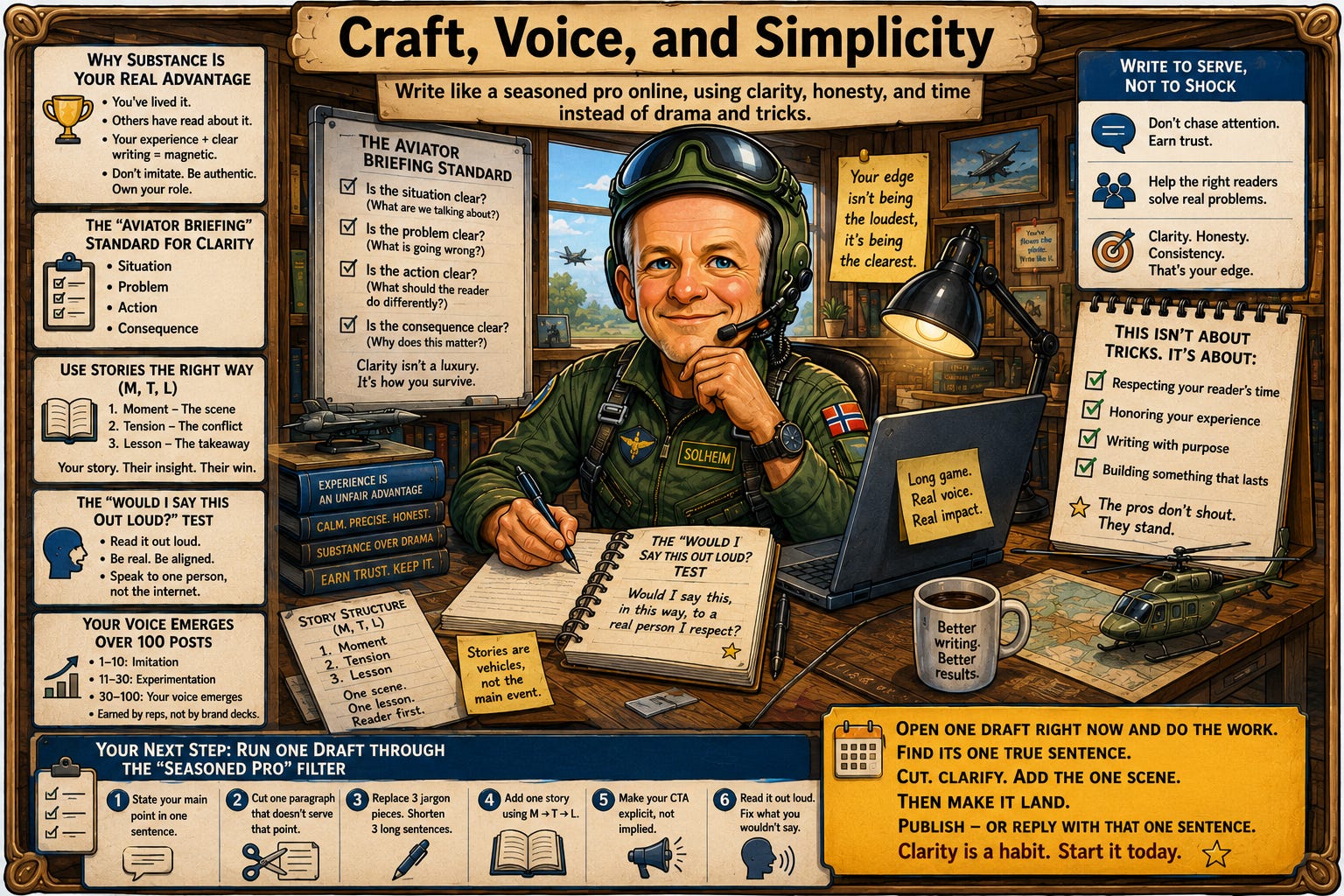
The “Aviator Briefing” Standard for Clarity
In aviation, clarity is not a luxury. It’ is how you survive.
Briefings are simple, direct, and repeatable. No one is trying to be poetic when they’re confirming a checklist before takeoff.
You can bring a version of that standard to your writing. Ask of every draft:
Is the situation clear? (What are we talking about?)
Is the problem clear? (What is going wrong?)
Is the action clear? (What should the reader do differently?)
Is the consequence clear? (Why does this matter?)
This doesn’t mean your writing has to be dry. It means that underneath any story or metaphor, the message is unmistakable.
You don’t need to memorize anything here. There’s a hands-on version of all this at the end of this post.
For now, just hold those four questions as the standard. You’re not writing briefing notes; you’re borrowing the discipline behind them to respect your reader’s time and attention.
Using Personal Stories Without Turning Your Newsletter into a Diary
One of the most common pieces of advice online is to share your story.
Also true, but also dangerous.
Left unchecked, share your story can easily drift into oversharing, self-indulgence, or simply talking about yourself more than you talk about the reader.
A simple way to keep stories useful is to use a three-step structure (M,T,L):
1. Moment - Describe a specific, concrete scene.
I was standing in the hangar at 05:30 am, staring at the checklist.
I was donning my karate gi after another long workday.
2. Tension - Name the decision, mistake, or conflict.
We were considering skipping a step on the checklist we thought we knew by heart.
Part of me wanted to skip training because I was ‘too busy.
3. Lesson - Connect it directly to the reader’s world.
Most of your online business tasks will feel like that checklist.
Your weekly writing block will feel like that late-evening training.
The story becomes a vehicle for the lesson, not the main event. You also protect your privacy, and that of others, by focusing more on the pattern than on the gory details.
The “Would I Say This Out Loud?” Test
Online, it’s easy to adopt a strange voice without noticing.
You add phrases you’d never use in conversation. You exaggerate, hedge and smooth the edges of the truth.
A simple way to guard your voice is to read your draft out loud and ask:
Would I say this, in this way, to a real person I respect?
If the answer is no, investigate:
Is this jargon I’ve unconsciously copied from the internet?
Am I softening the truth because I’m afraid of pushback?
Am I being harsher than I would be face-to-face?
Am I trying too hard to sound smart, edgy, or current?
Then rewrite until it passes the test.
This doesn’t mean your writing has to sound exactly like your speech. Writing has its own rhythm. But the tone should feel aligned. People trust writing that sounds like it came from a real, grounded person, not a persona.
Letting Your Voice Emerge Over 100 Posts
Many creators obsess over finding their voice before they’ve written much at all.
Voice is not discovered in a brand deck. It is forged in repetition.
In your first 10 to 20 posts, you are mostly imitating your influences. In your next 20 to 30 posts, you’re experimenting. Somewhere between posts 30 and 100, a tone and style begin to emerge that feel unmistakably yours.
You don’t get there by thinking about it. Just do the following:
Write regularly with a clear promise
Tell authentic stories that matter
Edit for clarity instead of cleverness
Pay attention to which posts feel most like you and resonate most with your readers
Your voice is the residue of thousands of small decisions: which adjectives you avoid, which you favor; how you handle nuance; how you talk about failure; how you treat the reader.
It’s a long game, which is good news. Because you have the time and the experience to play it.
Your Next Step: Run One Draft Through the “Seasoned Pro” Filter
Everything above is a standard to work towards. Here’s the hands-on version.
Take one draft, maybe a post you’re working on right now, and run it through these six steps:
State your main point in one sentence at the top. If you can’t find it, you’re not ready to publish, rewrite until you can.
Cut one paragraph that doesn’t serve that point. There’s almost always one.
Replace three pieces of jargon with plain language and shorten three long sentences while you’re in there.
Add one concrete story using Moment → Tension → Lesson. One scene, authentically told, aimed at the reader.
Make your call to action explicit, not implied. Tell them what to do next.
Read the whole thing out loud. Fix anything you wouldn’t say to a peer you respect.
You don’t need to transform your style overnight. You just need to nudge each piece a little more toward clarity, honesty, and groundedness.
Over a year, those small nudges compound. You develop a body of work that doesn’t shout, but stands.
And for the serious, constrained professionals you’re writing for, that’s exactly the kind of voice they’re hungry to hear.
So here’s your call to action. Don’t bookmark this for later, but open one draft right now, the one that’s been sitting unfinished, and run it through the six moves above. Find its one true sentence. Cut the paragraph that’s hiding. Add the one authentic scene.
Then do the thing the filter asks of every post: make it land.
Hit publish, or reply to this and tell me the single sentence your draft is really about. If you can say it in one line, you’re ready. If you can’t, you’ve just found your next hour of work, and that’s a better outcome than another bookmark.
Clarity is a habit. Start it today.