

One Page, One Point
Each post you write should have one main idea

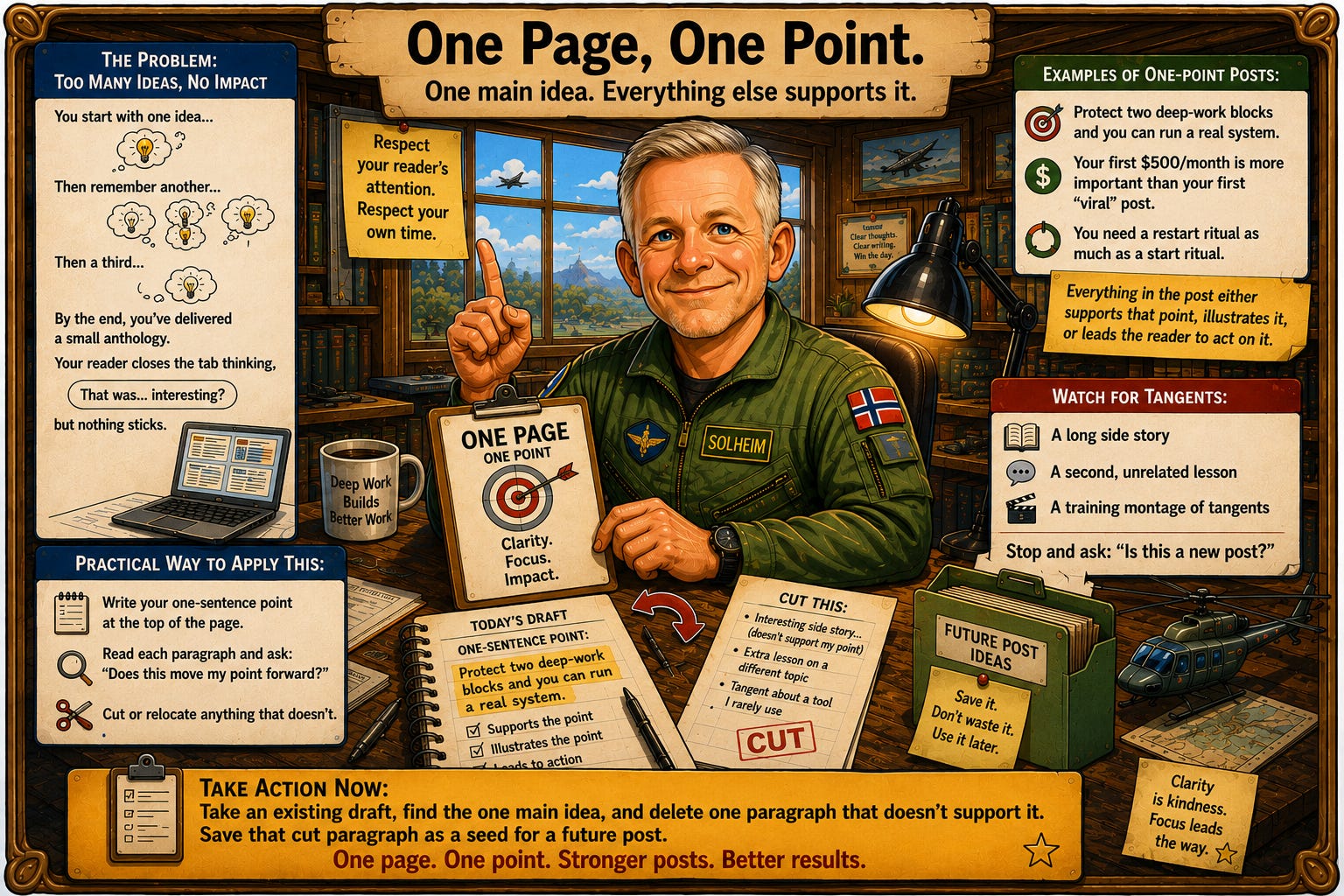
Weak posts often suffer from the same problem of trying to do too much.
You start with one idea and halfway through, you remember another idea and then a third. By the end, you’ve delivered a small anthology instead of a single sharp message.
Your reader closes the tab thinking, “That was… interesting?” but nothing sticks.
Here’s a rule that can quietly transform your output:
One page, One point.
Each post, should have one main idea, like the following examples;
Protect two deep‑work blocks and you can run a real system.
Your first $500/month is more important than your first ‘viral’ post.
You need a restart ritual as much as a start ritual.
Everything in the post either supports that point, illustrates it, or leads the reader to act on it.
If you find yourself adding:
A long side story
A second, unrelated lesson
A training montage of tangents
Stop and ask: “Is this a new post?”
Practical way to apply this:
Before drafting, write your one‑sentence point at the top of the page.
After drafting, read each paragraph and ask: “Does this move my point forward?”
Cut or relocate anything that doesn’t.
This is about respecting your reader’s limited attention and your own limited time by delivering one thing they can carry with them into their week.
Now it is your turn. Take an existing draft, find the one main idea, and delete one paragraph that doesn’t support it. Save that cut paragraph as a seed for a future post.
This focus on a single point is exactly why so many people get overwhelmed by automated writing tools. Left to its own devices, a machine will dump a whole bucket of competing concepts into a draft. It takes a thoughtful human eye to step in, sweep away the extra fluff, and make sure just one useful lesson actually lands with the reader.